

Fickle Fame

Fickle Fame is a confounding thing. It’s often the way that a well-regarded artist falls out of fashion. Despite the worthiness of his or her work, the artist is forgotten by subsequent generations. Even truly great artists can meet this fate: The 16th century poet John Donne was largely unknown until another poet, T.S. Eliot, rediscovered him in the 20th century. Almost nobody remembered Johann Sebastian Bach for a century until composer Felix Mendelssohn revived his music in the 1820’s.
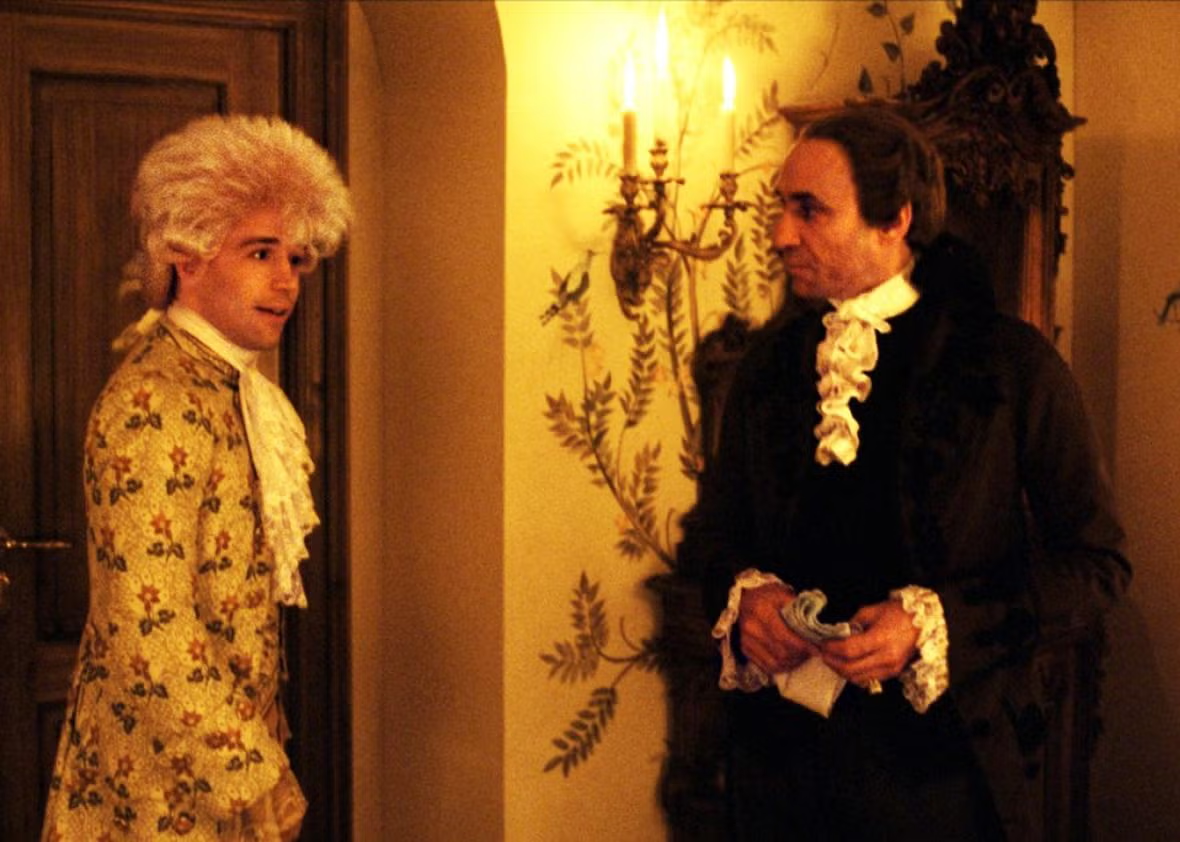
Not every forgotten artist has an Eliot or a Mendelssohn come to his rescue . . . although sometimes redemption comes from an unexpected direction. Consider the case of Antonio Salieri: had he not been cruelly libeled four decades ago by Peter Shaffer in the play & film Amadeus, in which he was portrayed as the murderer of Wolfgang Mozart, it is quite possible that his music would not be performed at all. Incidentally, Shaffer did few favors to the memory of Mozart either, who was the purported protagonist of his story.
A Good and Well-Respected Composer
The real story is that, although Mozart distrusted Salieri as an obstacle to his career when he first arrived in Vienna, the two eventually developed a friendly and respectful professional relationship. Salieri, in fact, responded very favorably to Mozart’s opera The Magic Flute, and in his final letter Mozart mentions taking Salieri to a musical performance in his own carriage. After Mozart’s death Salieri tutored the composer’s son Franz Xaver Mozart. Needless to say, Salieri did not murder Mozart (nor anyone else that we know of).
So, while Salieri was no Mozart (but who is?), he was a good and well-respected composer in his time, and a much sought-after teacher. In addition to Mozart’s son, he tutored Franz Liszt, Franz Schubert, and Ludwig Von Beethoven. The lovely piece below is the “Gloria” from Salieri’s Mass in B Flat, one of his four Masses.
Featured image top of page: The Holy Trinity by Pierre Mignard, 1663-1665
Discover more from Spes in Domino
Subscribe to get the latest posts sent to your email.
