

Lex Orandi, Lex Credendi
Lex Orandi, “the law of praying,” equals Lex Credendi, “the law of believing.” I’ll explore the practical application of this old aphorism in a moment. First, picture Sunday Mass in a typical parish. A mother comes up for communion holding a small child in her arms. As she approaches the priest, she awkwardly holds on to her infant with one arm. She uses the other to take the Eucharistic host and quickly pop it into her mouth before she drops it, or her squirming child, to the floor. I’ve witnessed this little dance on numerous occasions over the years.

I always wonder why the harried parent doesn’t avail herself of a simple and effective method of protecting both the safety of her son or daughter and the dignity of all the parties involved. That very much includes the dignity of Christ present in the Eucharist, by the way. She could simply hold her child securely in both arms, extend her tongue, and receive the Body of Christ in the same manner as her ancestors did for centuries before her. Happily, that manner is still, officially, the norm for the entire Church. More in that below.
Why Care About “Norms”?
But let’s set aside, for the moment, the issue of Church norms. Why should the young mother holding her baby care? Why should any of us for that matter care about “norms,” or about what our ancestors did? That is to say, what is the point of tradition?
The question of the value of tradition gained a certain currency a few years ago with Pope Francis’ motu proprio Traditionis Custodes. The purpose of the document was to restrict, and ultimately end, the Traditional Latin Mass (TLM). G.K. Chesterton called tradition “the democracy of the dead.” That is, it gives our forebears a “vote” in how we conduct ourselves here and now. This is something unique to humanity. It makes no difference to a cat, or a bat, or a moray eel whether it’s doing what its ancestors did. Animals are biologically programmed to behave exactly as previous generations have done. A dog doesn’t give the least thought to whether or not he should leave his mark on a given fire hydrant. He simply does it and moves on.
What is Man?

by Edward Dayes, 1798
We humans are different. We are, again, unique among the world’s creatures. We’re not subject to instinct, we alone can make free choices about how we act. Our Creator has endowed us with awareness of self, with the ability to make distinctions, to think abstractly:
[W]hat is man that thou art mindful of him, and the son of man that thou dost care for him? Yet thou hast made him little less than God, and dost crown him with glory and honor. Thou hast given him dominion over the works of thy hands; thou hast put all things under his feet, all sheep and oxen, and also the beasts of the field, the birds of the air, and the fish of the sea, whatever passes along the paths of the sea. O LORD, our Lord, how majestic is thy name in all the earth! (Psalm 8:4-9)
The second sentence above is sometimes reads, “Thou hast made him little less than the angels.” As with the angels, God has endowed us with great gifts. Like the angels we can forget the divine source of those gifts, and succumb to pride . . . and therefore fall.
The Power of Tradition
Tradition, if we pay attention to it, steers us away from that fall. For one thing, the experience of our ancestors and their choices, good and bad, guides us in sound decision-making. “Those who cannot remember the past are doomed to repeat it,” as George Santayana famously said. More than that, our ability to know how to act in most areas of life is only possible because of centuries of trial, error, and reflection. We stand on the shoulders of giants, as the old saying goes. The experience of our forebears helps us understand that we can claim little credit for our achievements.
Further, it and warns against the temptation of that pride which leadeth to the fall (see Proverbs 16:18). Curious, by the that those who most loudly trumpet the urgency of “lived experience” show so little interest in the experience that countless generations have lived before us.
And that’s just ordinary human tradition. Sacred tradition, tradition as preserved by the Church in scripture, doctrine, liturgy, and sacraments does even more than that, much more. It reveals to us the involvement of God in every part of the human story. It connects us directly to the life of God Himself. The highest expression of sacred tradition is the Eucharist as the True Body and Blood of Christ himself, and the Church as His Mystical Body.
Sacred vs. sacred
Before I go further, let’s note an important distinction. There’s Sacred Tradition, sometimes called Tradition with a capital T, and lowercase sacred traditions. Sacred Tradition with a capital T refers to essential elements of Catholic belief and practice that have existed from the beginning. Doctrinal definitions are one example. These cannot change. Lowercase traditions are things that are beneficial, even holy, but not essential. Devotional practices are an example. We can change theses or abrogate them if they are no longer helpful. The Mass contains both kinds of tradition. Among essential, unchangeable elements we include a validly consecrated priest, an altar, a victim, and a sacrifice. Non-essential elements (despite my fondness for Latin) include the language in which the Mass is conducted, and the posture we assume in receiving communion.
Just because we can change sacred traditions (as opposed to Sacred Tradition) doesn’t mean we should. Very often they fill an important role in the spiritual lives of believers, for example. There may be other detrimental effects if we set them aside without good reason. We can clearly see why this is so when we look at ordinary, human traditions. Consider the policy of totalitarian revolutionaries from time immemorial. One of the first things they do is to destroy established tradition. They try to undermine the traditional family by separating children from their parents and husband from wife. That’s why communists have often been champions of so-called “free love.” They abolish religion and secular associations that exist outside of their control. Totalitarians seek to erase any pre-existing sense of identity so that they can forge a new identity, and form people according to their own designs.
Sermons in Stone
It’s hard to avoid the conclusion that something similar has been happening in the Church for most of the past century. This goes back even before the Second Vatican Council.

Altruras, CA, 1883
Consider church architecture. Despite sometimes significant changes over time, any church built from the time Christians emerged from catacombs in the 4th century up until the mid twentieth century, from the humblest parish church to the grandest basilica, would be immediately recognizable for what it was. It was obviously of a kind with all the other churches. Moreover, sacred architecture has always used the elements of the building itself to evangelize, to act as a “sermon in stone.” It employed a balanced and hierarchical arrangement to represent the order of God’s universe. The interior design always drew the eye ultimately to the altar and the tabernacle at the center.
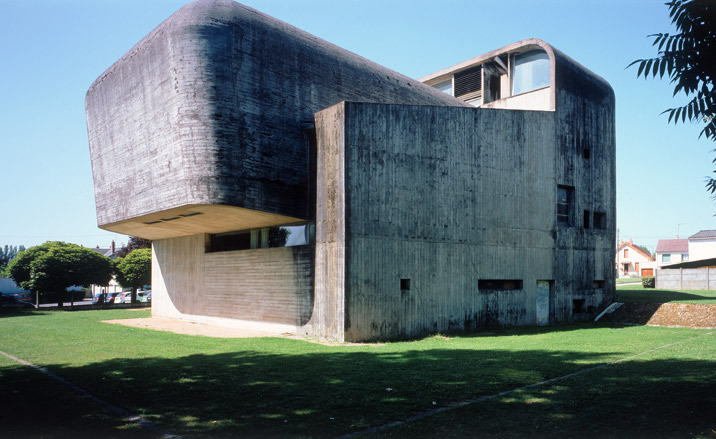
Somewhere during the twentieth century church architecture made a sudden turn in a radically different direction. We began to see church buildings that look like spaceships, or half-capsized boats, or mere angular jumbles of seemingly random chunks of concrete. The altar was an unremarkable table, and good luck finding the tabernacle. Instead of being “sermons in stone” the new churches spoke of nothing so much as the disorder in the mind of the human architects who designed them or of the confused churchmen who commissioned them.
Rash Unnecessary Violence
Something similar happened in liturgy. The “new” Mass that emerged in 1970 was significantly different from the reforms envisioned by the Second Council. And the actual implementation of the reformed liturgy took things even beyond the changes specified in the new Mass itself.
I’m not saying that the current liturgy is invalid; I am arguing that the radical changes there, as in architecture and other features in the life of the Church, have rashly and unnecessarily done violence to things that help draw Catholic believers closer to God and to each other.
I’d like to return briefly to the image I started out with, the mother or father juggling a squirming baby in one hand and the Sacred Body and Blood of Christ in the other. I noted that simply receiving on the tongue would be much more comfortable, efficient, and dignified, not to mention safer for the baby. Those advantages, however, are not the point: they are simply a happy consequence of what we ought to be doing anyway.
Reverence for the Presence of Christ
I’m not simply stating my personal opinion: communion on the tongue is the established rule. The Church clearly stated its official stance in 1969. That’s when the Sacred Congregation for Divine Worship promulgated its instruction Memoriale Domini. This is the document which grants permission for distribution of communion in the hand. We should note that this permission came only after a two-thirds vote of the regional bishops’ conference and confirmation by the Holy See. Significantly, the greater part of the instruction emphasizes why communion on the tongue is greatly preferable to receiving in the hand. It is emphatic that the traditional practice remains the rule (my bold):
. . . with a deepening understanding of the truth of the Eucharistic Mystery, of its power and of the presence of Christ in it, there came a greater feeling of reverence towards this sacrament and a deeper humility was felt to be demanded when receiving it. Thus the custom was established of the minister placing a particle of consecrated bread on the tongue of the communicant.
This method of distributing holy communion must be retained, taking the present situation of the Church in the entire world into account, not merely because it has many centuries of tradition behind it, but especially because it expresses the faithful’s reverence for the Eucharist . . .
The Apostolic See therefore emphatically urges bishops, priests and laity to obey carefully the law which is still valid and which has again been confirmed.
The reason for the rule is to show, and to help the recipient feel, the deepest reverence for the presence of Christ in the Sacrament. Lex orandi, lex credendi.
Fruitful Reception of the Body of the Lord
In any case, my point is this. Even if we don’t privilege one form of reception of the Eucharist over the other, why is there such resistance to the more traditional way, even to the point of risking injury to one’s own child? For that matter, why are most children taught the reluctantly granted exception, but not the actual norm? Why is there so much hostility to the traditional form?
“Hostility” is no exaggeration. And again, this is just one example of a much wider trend. Memoriale Domini says in defense of the traditional practice:
The custom [i.e., reception on the tongue] does not detract in any way from the personal dignity of those who approach this great sacrament: it is part of that preparation that is needed for the most fruitful reception of the Body of the Lord.
The Autonomous Human Self
If you that doubt promoters of the new practice object precisely to the gestures of humility inherent in the old, consider the following example. This is an excerpt from “progessive” Catholic commentator Peter Steinfels’ 2003 book A People Adrift. Steinfels dismissively describes the traditional communicant as “kneeling, eyes closed and tongue outstretched like a baby bird being fed.” He prefers a communicant who, as he puts it, “stood eye-to-eye with the priest or Eucharistic minister, touching objects previously handled by the priest alone.”

This refusal to submit ourselves to the wisdom of tradition (and, by extension, to the Divine Inspiration for those traditions) seems to be the motivating factor in much of the change that has happened in the Church over the past century. We can see this refusal manifested in the architectural innovations mentioned above. And along with it, the wanton destruction of the beautiful interiors of so many churches. Also note the avoidance of any discussion of sin, and the replacement of an emphasis on the holy and transcendent with a focus on the material and earthly (social justice, Liberation Theology). We are abandoning the things that point us to God in favor of the merely human. Are we surprised that more and more people are deciding that they simply don’t need the Church at all?
The overriding concern here is not the reverence due to the Lord of the Universe. In fact, it seems to be altogether forgotten in the power struggle with His human priest. The focus here is the assertion of the Autonomous Human Self. So much for standing on the shoulders of giants.
Dropping the Baby
It should also come as no surprise that areas of growth in the Church are those places that embrace tradition. Religious orders that emphasize wearing a habit and adhering to Church teaching, dioceses and parishes that embrace Church teaching the traditional elements in the new Mass. And, of course, the Traditional Latin Mass itself. This what concerns me most about Traditionis Custodes and the trends associated with it. Instead of seeing that growth as a positive thing that brings more people closer to Christ, and therefore as something we should work to inculcate more widely in the Church, it has embraced the same hostility that took sledgehammers to beautiful, inspiring marble altars and communion rails. We risk dropping the baby on the floor.
Featured image top of page: Communion Midnight Mass (Evans/Getty Images)
Discover more from Spes in Domino
Subscribe to get the latest posts sent to your email.

5 thoughts on “Lex Orandi: Has Tradition Become a Dirty Word?”